What is MRV in forestry carbon?
MRV stands for monitoring, reporting, and verification: the process by which a forestry carbon project measures what is happening on its land, documents those measurements against a registry methodology, and submits the result for independent audit. It is the mechanism that turns trees in the ground into carbon credits a buyer can trust. Without MRV there is no credit, because there is no evidence that the claimed emissions reductions actually occurred.
In practice, forestry carbon projects are too often judged on the quality of their monitoring evidence rather than only the quality of their climate outcomes. When MRV remains manual and fragmented, it becomes difficult for buyers and verification bodies to trust whether a project truly delivered what it claims — and that credibility gap makes it harder for good projects to access finance.
Why does manual MRV fall short?
Manual MRV places a heavy burden on project developers, who must coordinate field teams, capture measurements, and then assemble that material into registry reports. That workflow creates many opportunities for gaps, delays, and inconsistencies to appear. Four failure points recur across projects:
- Cost — the field labour and consultant time needed for each monitoring cycle limits how often a project can afford to measure.
- Fragmentation — data is scattered across spreadsheets, devices, and field notebooks, making it slow to reconcile into a single record.
- Auditability — when observations are typed in by hand and disconnected from their location, evidence is hard for a verifier to trace back to the plot it came from.
- Eligibility screening — land assessment depends on GIS expertise that many developer teams do not have in-house, which stalls projects before they start.
The result is a trust gap with buyers and auditors, who need clear, defensible evidence before they can place confidence in a carbon claim.
What is digital MRV (dMRV)?
Digital MRV, or dMRV, replaces those manual steps with structured data capture, remote sensing, and automated reporting so that evidence is collected in an audit-ready form from the moment it leaves the field. Rather than logging individual measurements and reconciling them later, dMRV keeps every observation tied to a location, a timestamp, and a methodology requirement throughout the project lifecycle. Flora Carbon AI builds dMRV tooling for each stage of that lifecycle:
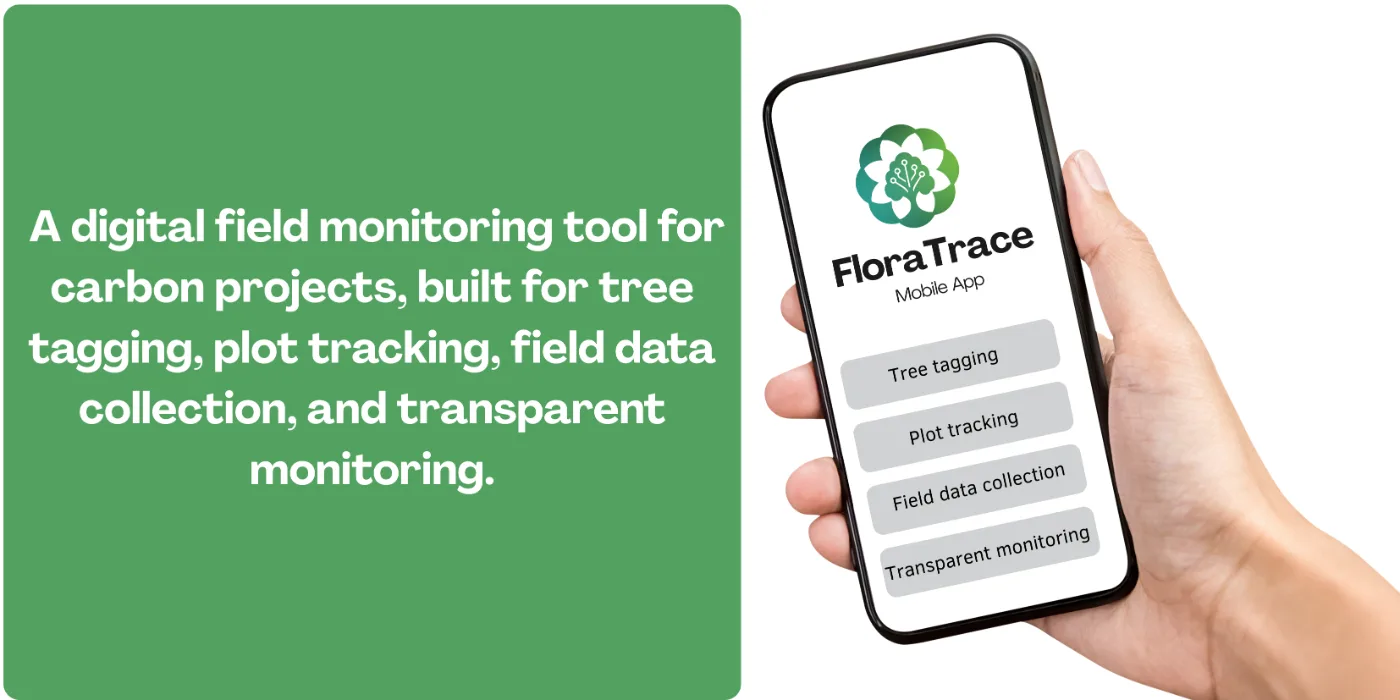
- FloraTrace — QR-based tree tagging and GPS plot tracking for tamper-resistant field data capture.
- FloraScope — satellite-based land screening, land-use and land-cover mapping, and spatial monitoring without in-house GIS expertise.
- FloraCarbon Calculator — sequestration modelling across Gold Standard, VCS, and CDM methodologies.
- FloraGPT — support for methodology selection, PDD drafting, and audit preparation.
You can see how these fit together across our live work on the projects we support in India, Timor-Leste, and the Amazon.
Which carbon standards and project types does this cover?
Flora Carbon AI aligns its work with the major registry frameworks rather than a single standard, because project developers rarely stay inside one. The table below maps the standards we work with to the project types where digital evidence makes the most difference.
| Framework | Typical project types | Where dMRV helps most |
|---|---|---|
| Gold Standard | Agroforestry, afforestation and reforestation | Smallholder aggregation and per-plot evidence |
| Verra (VCS) | ARR, REDD+, improved forest management | Baseline mapping and change detection |
| Plan Vivo | Smallholder and community forestry | Participant tracking across many small plots |
| CDM | Afforestation and reforestation | Sequestration modelling against fixed methodologies |
| ICR | Blue carbon, mangrove restoration | Spatial monitoring in complex tidal landscapes |
What does this mean for project developers?
For project developers, digital MRV reduces uncertainty and improves decision-making. Instead of navigating a maze of disparate reports, teams work from a single evidence base already aligned to registry requirements, which shortens the path from field implementation to verification. Our work on agroforestry with around 100 farmers in India and a 2,000+ farmer project in Timor-Leste shows what that looks like when the participant count makes manual reconciliation impractical.
To understand the team and the thinking behind the platform, read more about how Flora Carbon AI approaches the MRV gap.