
Why does India need digital MRV specifically?
Digital MRV matters in India because of landholding structure rather than anything about the carbon science. Indian agroforestry carbon projects aggregate outcomes across very large numbers of small, fragmented plots held by individual farmers. A methodology that assumes a contiguous estate with one owner behaves very differently when the same hectarage is split across hundreds or thousands of participants, each of whom must be individually traceable for the project's claims to survive verification.
That is an evidence-handling problem before it is an agronomic one. Manual reconciliation across that many participants does not fail gracefully — it fails at audit, years after the data was collected, when returning to the field to fix it is no longer possible.
What carbon projects does Flora Carbon AI run in India?
Flora Carbon AI is a Kolkata-headquartered company working on nature-based carbon projects in India and internationally. Our Indian work covers two distinct project types:
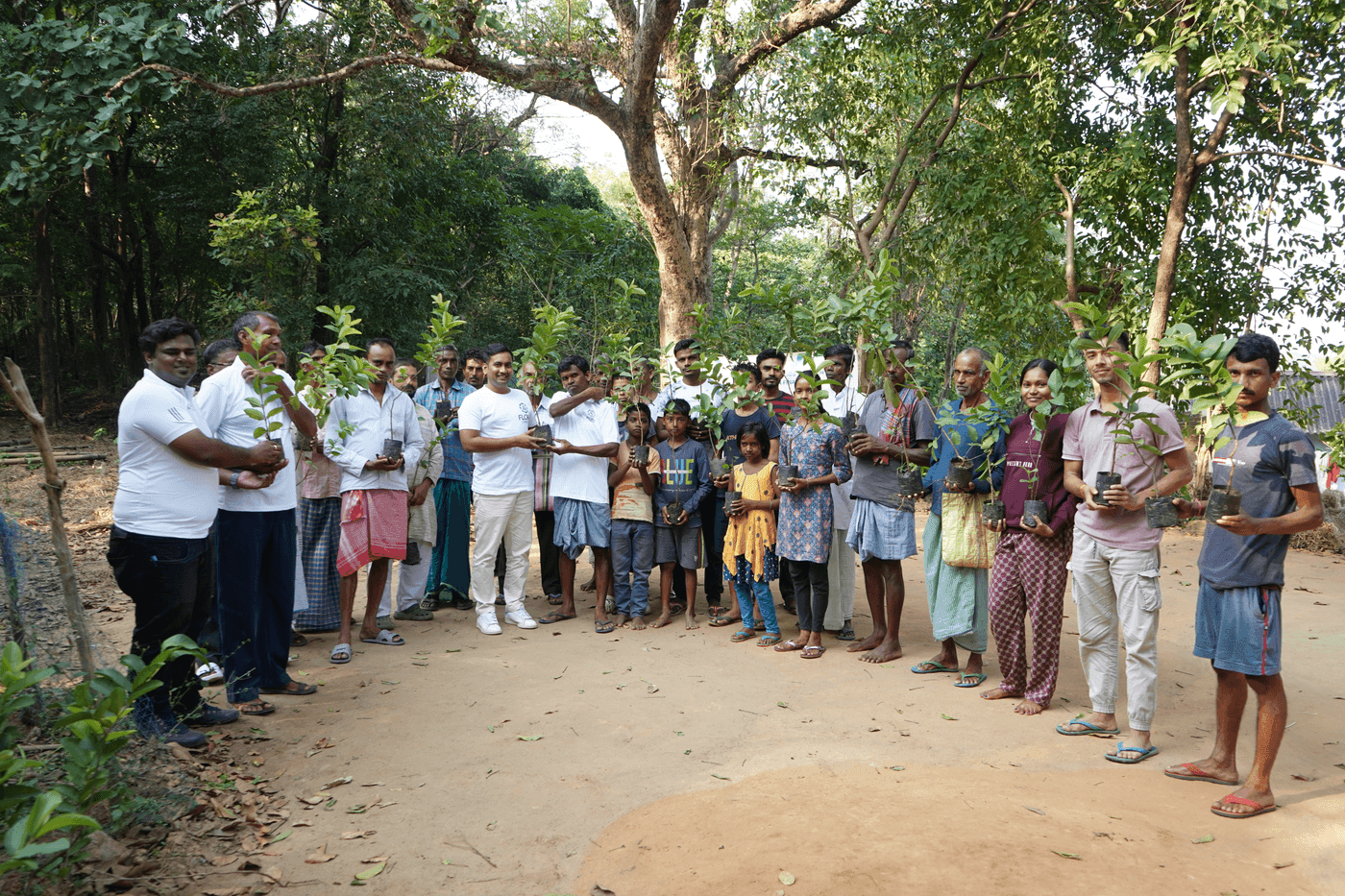
- West Bengal agroforestry — supporting a carbon project with around 100 farmers, integrating trees into working farmland in a way that supports both sequestration and livelihoods.
- The Sundarbans — mangrove reforestation monitoring, where FloraScope handles land screening and land-use and land-cover mapping across a tidal landscape that is difficult to survey on foot.
Both are covered in more detail in our field report from the Sundarbans and Timor-Leste. The Sundarbans work is also the clearest example of why blue carbon monitoring differs from terrestrial forestry.
How does carbon finance reach smallholder farmers?
Carbon finance reaches smallholder farmers through aggregation: a project developer or FPO groups many individual landholdings into a single project that can bear the fixed costs of development, validation and verification. No individual smallholding generates enough credits to justify those costs alone. The aggregation model is what makes participation possible — and per-participant traceability is what makes the aggregation defensible.
- Individual plots are registered with their boundaries and participant identity recorded, not estimated.
- Planting and survival are tracked per participant so benefit-sharing can be evidenced.
- Monitoring recurs over the crediting period, which for tree-based projects runs for decades.
- The evidence base has to remain queryable across that whole span, not just at the next audit.
What makes Indian land eligibility assessment hard?
Eligibility assessment in India is complicated by plot size, fragmentation, and the quality of historical records. Methodologies require evidence of prior land use over a lookback period, which means historical satellite imagery rather than a site visit — and at smallholding scale, the parcels being tested are often smaller than the features a coarse analysis would resolve. Land tenure adds a second layer, because the right to claim the carbon is a legal question that has to be settled per participant.
This is the specific gap FloraScope was built for: satellite screening and land-use mapping that a project team can run without engaging a GIS consultant per parcel. The carbon project development guide covers where eligibility sits in the wider pipeline.
Which standards apply to Indian carbon projects?
Indian forestry and agroforestry projects are developed under the same international frameworks used elsewhere — Gold Standard, Verra (VCS), Plan Vivo, CDM and ICR — with the choice driven by activity type and intended buyer. Flora Carbon AI aligns its work with all five rather than a single registry. For afforestation, reforestation and revegetation under Verra specifically, see the VM0047 guide.
Those are the international routes. India also has a domestic compliance market of its own — the Carbon Credit Trading Scheme, notified on 28 June 2023 — whose offset mechanism is open to eligible projects developed by non-obligated entities. Our CCTS explainer covers how the scheme works and how its two mechanisms differ.