
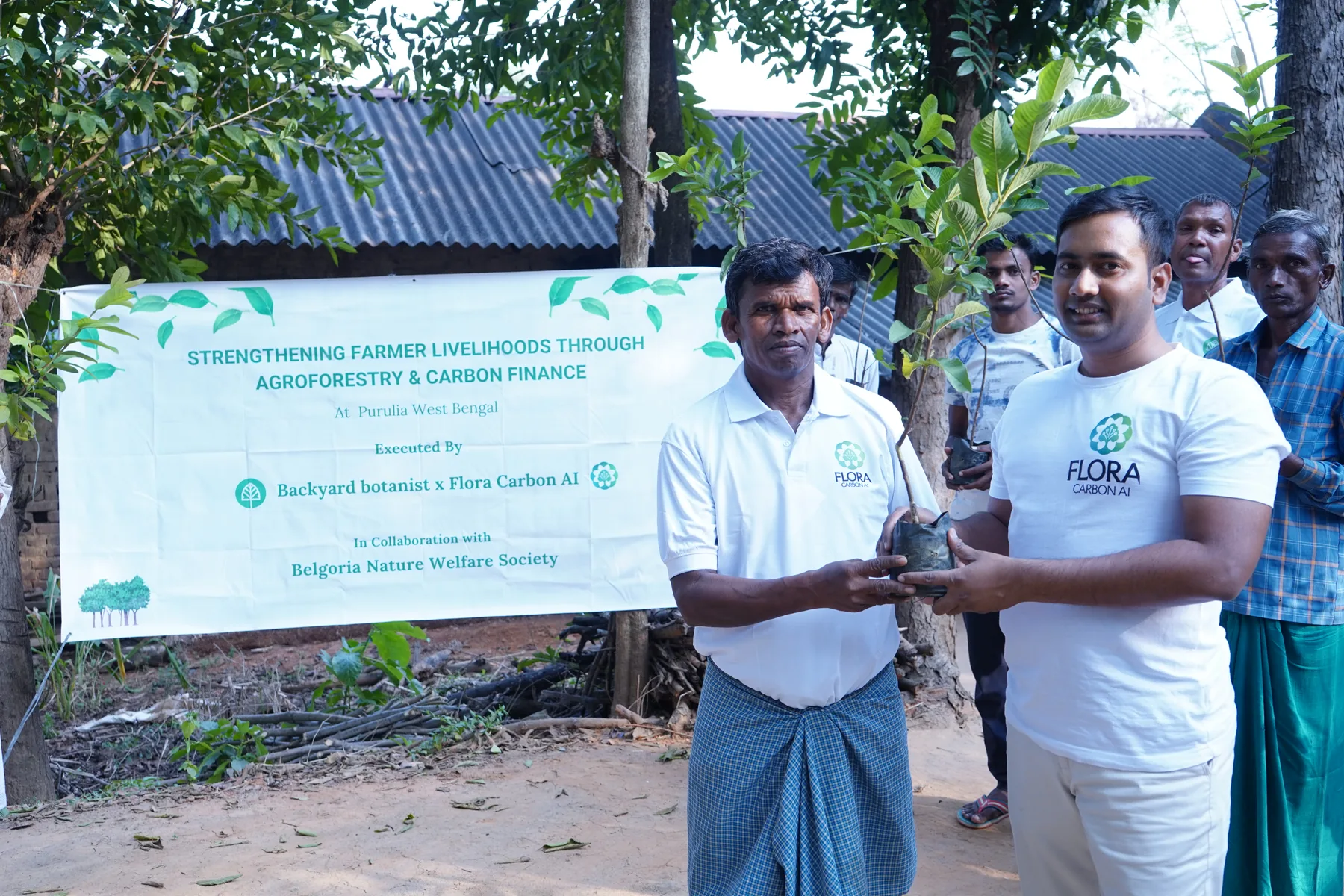
Sapling handover in Flora Carbon AI's West Bengal agroforestry programme

Projects in the field

Projects we're building

From Uganda to the Amazon, from farm boundaries in West Bengal to mangroves in the Sundarbans, Flora Carbon AI works with project developers, foundations and communities to design carbon projects, monitor them in the field and support certification.

04

Programmes

03

Continents

45

Year crediting period

100k

Hectare long-term target

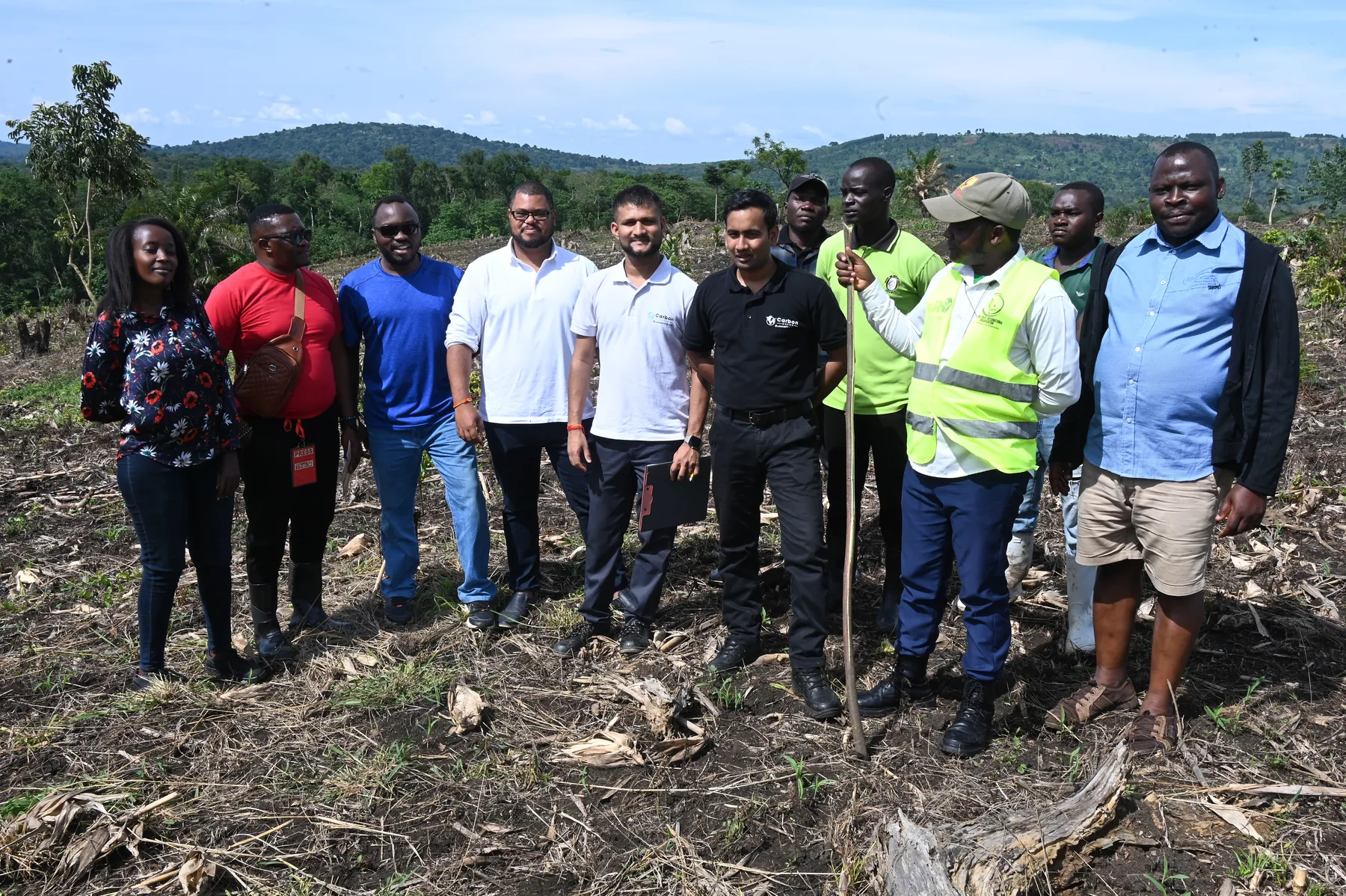
GRO Foundation and Flora Carbon AI teams at the Uganda project site
Developer
GRO Foundation
Registry
International Carbon Registry (ICR)
Methodology
AR-ACM0003 v2.0 — Afforestation and reforestation of lands except wetlands
Status
Validated and registered, January 2025
Crediting period
45 years
Our role
Digital MRV · monitoring, reporting & verification support · certification workflows
Project 01

Uganda · Afforestation & Reforestation · International Carbon Registry (ICR)

GRO Foundation · Uganda

Bright Future Africa — Vol. 2

GRO Foundation is planting indigenous trees across deforested institutional land in Uganda, at a scale few projects attempt — a registered afforestation and reforestation programme under the International Carbon Registry with a 45-year crediting period. The programme is built on a census-based accounting approach, measuring sequestration species by species rather than relying on broad averages.

That level of precision is exactly where most projects run into trouble. Census-based accounting only works if every tree can actually be found, identified and re-measured years later — across thousands of hectares, through multiple verification cycles.

That's where we come in. Flora Carbon AI provides the digital MRV layer for the project: per-tree tagging and geolocation, structured field data capture, and registry-grade monitoring reports that hold up under third-party verification. We also support the project through its certification workflows, so the evidence generated in the field arrives at the validator in the form it's expected in.
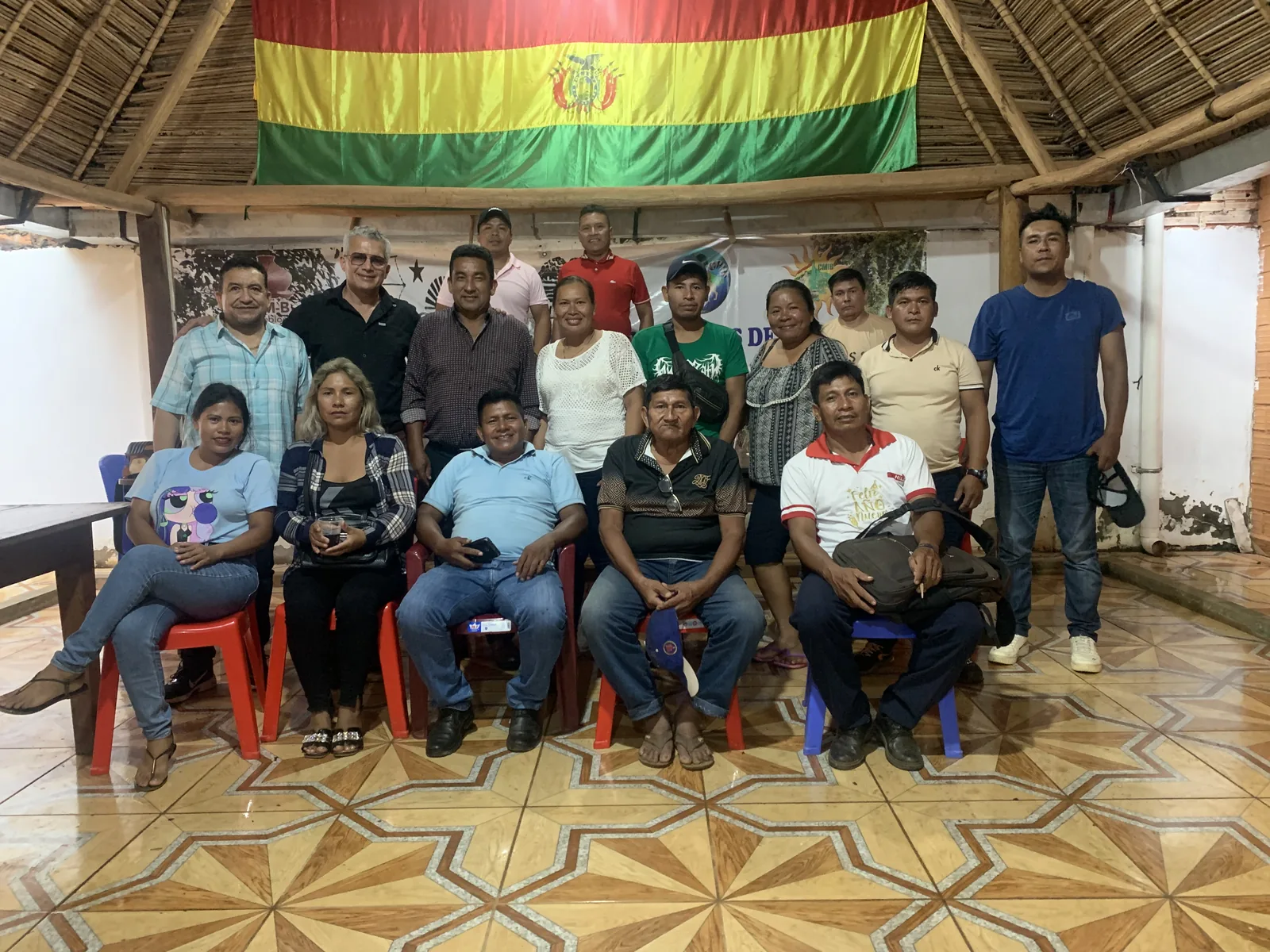
Ora Ecologica meeting with local partners in Bolivia
Partner
Ora Ecologica (United States)
Geography
Amazon basin — Colombia, Brazil, Peru, Bolivia
Project type
Large-scale forest restoration
Status
Early-stage design and development
Our role
Project design · feasibility & baseline work · MRV architecture
Project 02

Colombia · Brazil · Peru · Bolivia · Early-stage development

Ora Ecologica · Amazon Basin

Large-scale Amazon restoration with Ora Ecologica

We're working with Ora Ecologica, a United States–based restoration organisation, on a multi-country Amazon restoration programme spanning Colombia, Brazil, Peru and Bolivia.

A project of this footprint can't be designed the way a single-site project is. Four countries means four sets of land tenure rules, four regulatory contexts, and ecological conditions that shift across the basin. The methodology and baseline decisions made now determine whether the programme can scale later or gets stuck re-doing its own foundations.

The project is at an early stage, and that's deliberately where we're most useful — feasibility screening, methodology selection, baseline and carbon estimation, and designing the MRV architecture before a single hectare is committed. Getting these choices right at the concept stage is the difference between a programme that scales across the basin and one that stalls in its first verification.

We'll share more as the programme develops.

Sapling handover in the West Bengal agroforestry programme
Location
Purulia district, West Bengal — expanding nationally
Standard
Gold Standard
First instance
3,000 ha, phased
Long-term target
100,000 ha across India
Beneficiaries
Smallholder and marginal farmers, FPOs, village communities
Our role
End-to-end project development · FloraTrace per-tree MRV · certification
Project 03

West Bengal, India · Smallholder agroforestry · Gold Standard

Agroforestry · India

Strengthening farmer livelihoods through agroforestry and carbon finance

India has one of the highest concentrations of small and marginal farmers anywhere in the world — the people with the most to gain from a second, predictable income stream, and the least ability to access one. Carbon finance should reach them. In practice, transaction costs usually mean it doesn't.

We're building a farmer-centric agroforestry programme designed to change that, starting from a pilot in Purulia district, West Bengal. Purulia sits on the eastern fringe of the Chotanagpur Plateau: shallow red-lateritic soils, roughly four-fifths of cultivation rainfed, large stretches of degraded and low-productivity land alongside existing tree-based livelihoods in lac and tasar sericulture. It's difficult farming country, and precisely the kind of landscape where agroforestry does the most good.

What this programme will not do is convert prime cropland to forest. Instead we integrate native, locally suitable species into working farms — boundary planting along field perimeters, row-and-alley intercropping, block plantations on marginal plots, homestead and orchard enrichment, riparian and shelterbelt strips. Farm productivity and food security are preserved or improved while carbon stocks build steadily. Species are chosen for what farmers actually want from them: timber, fodder, fruit, fuelwood and NTFPs, matched to local rainfall, soils and market access.

The programme is structured as a grouped project, so new farmer plots can be added continuously rather than requiring a new project each time. The first instance covers 3,000 hectares in phases — beginning with the Purulia cluster, then additional village clusters across West Bengal — building toward a national programme of 100,000 hectares.

Every tree is tracked individually. Through FloraTrace, our QR-based mobile and web platform, each sapling receives a unique Tree ID linked to its GPS location, planting details, photographs and subsequent growth measurements — auditable, per-tree digital evidence across the full project duration. That's what keeps monitoring costs low enough for smallholder carbon to work at all.

Farmers gain diversified produce and annual carbon incentives; landscapes gain tree cover, soil health and resilience; buyers gain credits backed by per-tree evidence.

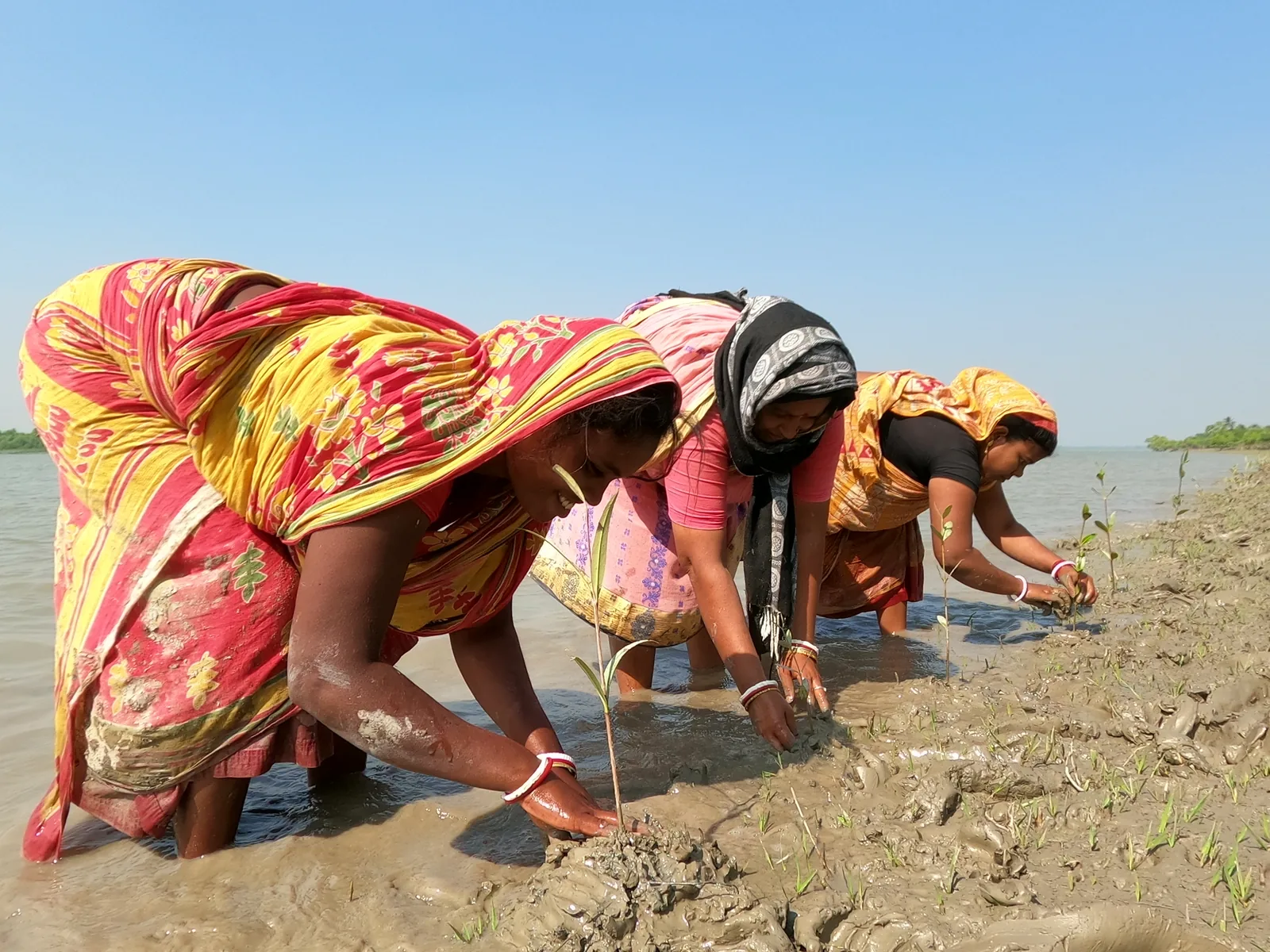
Women planting mangrove saplings in the Sundarbans
Location
Sundarbans, West Bengal
Ecosystem
Mangrove / coastal blue carbon
Status
Pilot completed
Communities
Coastal and island villages
Our role
Pilot design · field data capture · blue carbon MRV
Project 04

West Bengal, India · Mangrove restoration · Pilot complete

Sundarbans · Blue Carbon

Sundarbans blue carbon

The Sundarbans are where climate change stops being an abstraction. Cyclones, saltwater intrusion and eroding embankments are already reshaping livelihoods across the delta, and the mangroves that buffer these communities are among the most carbon-dense ecosystems on earth.

We've completed a pilot for a blue carbon project in the Sundarbans, developed with India's domestic carbon market in mind — testing how mangrove restoration can be measured and verified to a standard that stands up, while directing carbon revenue to the coastal communities who protect and depend on these forests.

Blue carbon is harder to measure than terrestrial forest. Biomass sits below ground as much as above it, tidal conditions limit when field teams can work at all, and the sediment carbon that makes mangroves so valuable is the part conventional forestry methods handle worst. The pilot was about proving we can capture that data reliably before scaling — which is what we're now working toward.

Build with us

Working on a carbon project?

Whether you need a project designed from scratch, an MRV system that survives verification, or expert review at one difficult stage, we would like to hear what you are building.