What makes a carbon project high-integrity?
Planting trees is often presented as a simple climate solution: plant more trees, absorb more carbon, generate carbon credits. In reality, developing a credible nature-based carbon project is much more complex. A successful project is defined not only by the number of trees planted but by whether it can demonstrate real, measurable, additional and durable climate benefits while maintaining environmental and social integrity.
1. Why does a clear and credible baseline matter?
Before calculating how much carbon a project can remove or avoid, it is necessary to understand what would happen without the project. This is the baseline scenario. The project must determine, for instance, whether a piece of land would naturally remain degraded or continue to be used for low-productivity purposes, because its climate impact is evaluated against that reference. A weak baseline can result in an inaccurate estimate of the actual climate benefit.
2. What is additionality, and why does it matter?
A carbon project should demonstrate that the claimed climate benefits would not have happened in the same way without carbon finance or the project intervention. For nature-based projects, this can involve assessing existing land-use practices, financial conditions, regulatory requirements and other factors that influence whether the proposed activity would happen anyway.
3. What does the right species in the right place mean?
Carbon sequestration is not simply about planting as many trees as possible, and species selection plays a key role. It should consider:
- Soil and climatic conditions
- Water availability
- Growth characteristics
- Native or locally appropriate species
- Biodiversity considerations
- Long-term survival
- Management requirements
- Local livelihood needs
A scientifically designed project can provide benefits beyond carbon, including biodiversity improvement, soil protection, livelihood opportunities and ecosystem restoration.
4. Why must carbon be measured, not assumed?
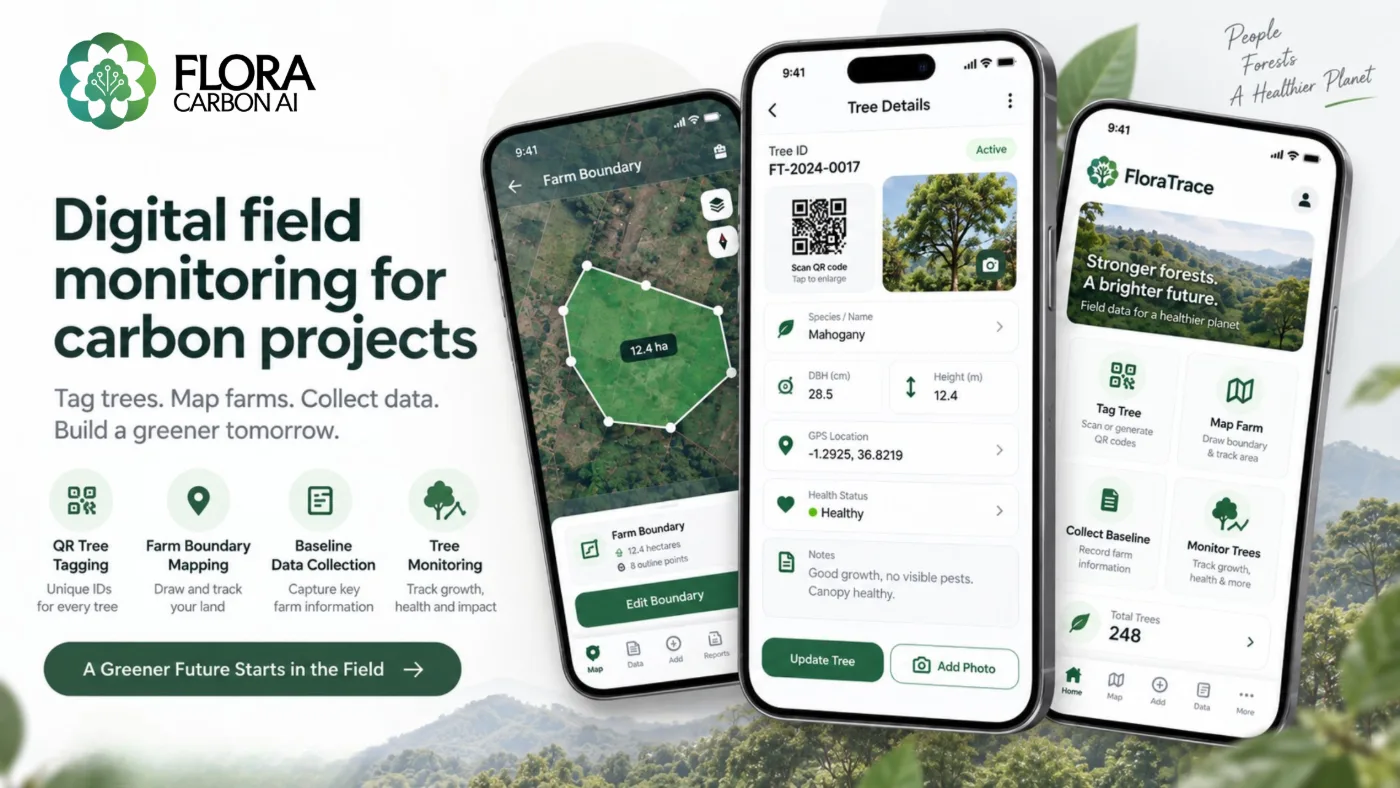
A project cannot estimate carbon from the number of saplings planted alone. Tree growth, survival, biomass accumulation and changes in land use need to be monitored from time to time, which is where Measurement, Reporting and Verification (MRV) becomes critical. Combining field data with GIS, remote sensing and digital tools can improve the quality, consistency and traceability of project data.
5. How do permanence and risk affect a project?
Carbon stored in forests can be affected by fire, drought, pests, disease, storms, illegal harvesting and changes in land management. A credible project therefore considers the risk of carbon loss and establishes long-term management and monitoring systems. The objective is not just to show carbon storage today, but to maintain it over the relevant project period.
6. What is leakage, and why can't it be ignored?
A project may appear to reduce emissions within its boundaries while unintentionally shifting the same activity somewhere else. Restricting a particular land-use activity in one area, for example, could cause it to move to another location. This potential displacement needs to be assessed and, where applicable, accounted for.
7. Why are people part of the project?
Many nature-based projects involve farmers, landowners and local communities. A high-integrity project should therefore consider:
- Clear land and participation arrangements
- Transparent benefit-sharing
- Farmer and community engagement
- Long-term incentives for maintaining the project
- Traceability of project-related payments
When communities benefit from a project's success, long-term project sustainability can become much stronger.
8. How can technology strengthen transparency?
Modern carbon projects increasingly combine field-level information with satellite imagery, GIS, data analytics and digital MRV systems. Technology can help answer important questions:
- Where is the project?
- What was planted?
- How much survived?
- How is the project changing over time?
- How much carbon is being stored?
- Can the information be traced back to its source?
However, technology should support scientific methodology and not replace it.
How do you build carbon projects for the long term?
High-integrity carbon projects require much more than planting trees and calculating tonnes of CO₂. They require a complete system connecting land assessment, project design, carbon modelling, field implementation, monitoring, documentation and verification. At Flora Carbon AI, we work at this intersection of climate science and technology, supporting carbon project developers with project assessment, carbon project development, consultancy and digital tools for monitoring and documentation.
The future of nature-based carbon projects will not simply be about creating more projects. It will be about creating better projects, with stronger science, better data and greater transparency. If you are developing one, get in touch.